





Sign-Up for Ivory Updates
The Obama administration and state lawmakers have proposed bans on legally-owned ivory products in the United States, claiming that such bans are necessary to preserve African elephants. While the NRA supports efforts to stop poaching and the illegal trade of ivory, these proposals would do nothing to protect elephants in Africa and Asia, but would instead make sellers of legal ivory potential criminals overnight, as well as destroy the value of property held by countless gun owners, art collectors, musicians and others. If you would like more information on this topic as it becomes available, please fill out the below form.
Ivory has been used in gun making for centuries, just as it has been used in fine furniture, jewelry and musical instruments. Ivory is widely used in rifle and shotgun sights and sight inserts, and for ornamental inlays in rifle and shotgun stocks. Custom handguns—such as General George S. Patton’s famous revolvers—are also often fitted with ivory grips.[1] Ivory is also commonly used in related accessories used by hunters and fishermen, such as knife handles, and handles for gun cleaning equipment and tools.
For decades, the United States has generally banned the commercial importation of African elephant ivory, other than antique items more than 100 years old; it also bans the commercial export of all raw ivory and strictly regulates export of worked ivory.[2] However, legally imported ivory may be sold within the U.S., because the Fish and Wildlife Service (FWS) has long presumed that most ivory in the U.S. was legally imported and that its sale in the U.S. would not increase poaching.[3]
If the Obama administration and some state lawmakers proceed with newly proposed ivory bans, the sale of all of the aforementioned items would be illegal and effectively lose their value with a stroke of a pen.
While the goal of restricting illegal commerce in endangered species is laudable—hunters in America and around the world are second to no one in seeking protection and restoration of species such as elephants and rhinos—the effects of a ban on legally owned ivory are disastrous for American gun owners and sportsmen.
Why the NRA opposes banning lawfully-owned ivory in the U.S.:
- Even for items at least 100 years old, the burden of proof would be on the seller to show that the ivory is old enough—a nearly impossible task, since a firearm or other item more than 100 years old may have been restored with newer ivory parts. Meeting FWS standards of proof would be challenging and expensive, as FWS will require evidence such as scientific testing, a “qualified appraisal,” or other “detailed history” information ranging from family photos to “ethnographic fieldwork.”[4]
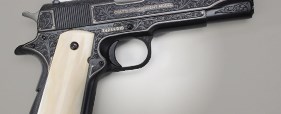 The proposed bans demand rigorous documentation to sell ivory that is more than 100 years old, documentation that private individuals typically do not have. Furthermore, there would be no accommodation for the numerous items made of legal ivory after 1915. Such items could not be sold, even with supporting documentation, and property that cannot be sold is radically diminished in value.
- The NRA supports efforts to stop poaching and the illegal ivory trade, but the proposed restrictions on domestic sales of legally-owned ivory —from elephants taken long ago—will not reduce the poaching of elephants or illegal trafficking in ivory. On the contrary, a ban would affect only honest Americans by making their ivory—acquired lawfully and in good faith—worthless.
At the Federal Level:
- On February 11, 2014, the Obama administration announced a “National Strategy for Combating Wildlife Trafficking” and a proposal to ban all U.S. commercial trade in elephant ivory.
- On February 25, 2014, FWS released a “Director’s Order” broadening the 1989 moratorium on commercial ivory importation to include many previously importable antiques, in part by imposing new and burdensome requirements on importers, exporters and sellers to prove that their ivory is more than 100 years old. [5]
- On May 27, 2014, the Obama Administration announced a final rule that amends implementing regulations under the Convention on International Trade in Endangered Species (CITES) and purports to apply those regulations to lawful domestic trade, which is outside the scope of the treaty.
- Now, through a yet-unpublished proposed rule under the Endangered Species Act (ESA), the FWS plans to revoke current allowances for domestic sale of lawfully imported elephant ivory.
Fortunately, revocation of the exception for domestic sales will require a rulemaking process—which will give concerned citizens, and Congress, an opportunity to make their voices heard.
At the State Level:
In 2014, New York and New Jersey followed the federal government’s lead and enacted laws prohibiting the sale and trade of ivory, including ivory from mammoths, animals that have long been extinct. Now, owners of legally-obtained ivory products face proposed ivory bans in other states, in which legislation mirroring New York’s and New Jersey’s laws have been introduced.
[1] See John Elliot, “The Known and Lesser Known Carry Guns of George S. Patton,” available at http://www.guns.com/2011/06/17/the-known-and-lesser-known-carry-guns-of-george-s-patton/.
[2] 50 C.F.R. § 17.40(e).
[3] Id.; U.S. Fish and Wildlife Service, Endangered and Threatened Wildlife and Plants; Proposed Endangered Status for Certain Populations of the African Elephant and Revision of Special Rule, 56 Fed. Reg. 11392, 11398-400 (March 18, 1991).
[4] See http://www.fws.gov/international/pdf/directors-order-210-questions-and-answers.pdf.
[5] See U.S. Fish and Wildlife Service, Director’s Order No. 210, Feb. 25, 2014, available at http://www.fws.gov/policy/do210.pdf; see also http://www.fws.gov/international/pdf/directors-order-210-questions-and-answers.pdf.


 More Like This From Around The NRA


