




 McDonald" height="768" width="576" />
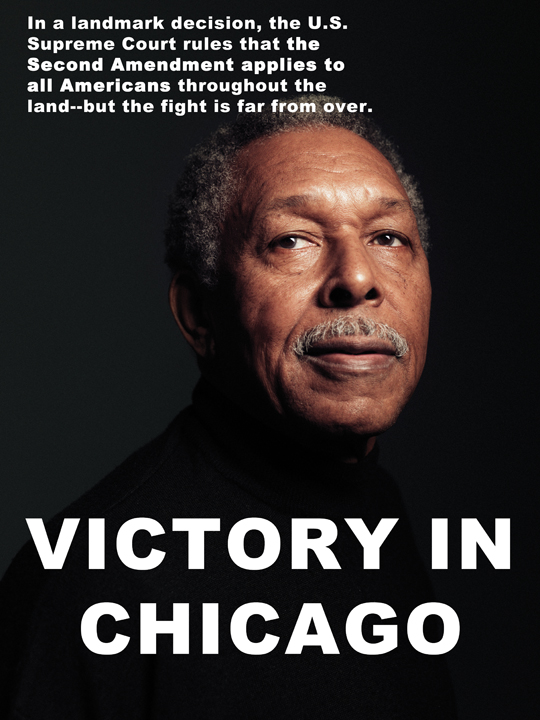
On June 28, 2010--two years and two days after declaring that the Second Amendment protects an individual right to possess handguns for self-defense--the Supreme Court of the United States declared just as clearly that the Second Amendment protects that right not just in Washington, D.C., and federal enclaves, but in every state, city and town in America. The decision is a great victory for gun owners--but also highlights the need for us to keep being politically active, now and forever.
The ruling came in the case of McDonald v. City of Chicago, a challenge to handgun bans in Chicago and Oak Park, Ill. The plaintiffs in the case were Chicago residents who wanted to keep handguns in their homes for self-defense, but couldn’t do so under the city’s nearly 30-year-old handgun ban. McDonald and a similar case brought by NRA were consolidated in the Seventh Circuit U.S. Court of Appeals. The Supreme Court made NRA a party to McDonald when it decided to hear the appeal.
In an opinion by Justice Samuel Alito, the Court announced: “We have previously held that most of the provisions of the Bill of Rights apply with full force to both the Federal Government and the States. Applying the standard that is well established in our case law, we hold that the Second Amendment right is fully applicable to the States.”
Joining Justice Alito were Chief Justice John Roberts and Justices Anthony Kennedy, Antonin Scalia and Clarence Thomas. These five justices also made up the majority in District of Columbia v. Heller (2008), in which the Court ruled that the Second Amendment protects a pre-existing, individual Right to Keep and Bear Arms and struck down D.C.’s bans on handguns and operable firearms in the home. Dissenting in McDonald were Justices Stephen Breyer, Ruth Bader Ginsburg and John Paul Stevens, all of whom dissented in Heller, and Justice Sonia Sotomayor, appointed to the Court last year by President Barack Obama.
|
WHAT’S THE NEXT BIG CASE? NRA will follow up the win in McDonald with more legal challenges to ensure that anti-gun politicians and judges don’t turn this latest victory into a practical defeat. Right now, no one knows what case will be the next milestone in the history of the Second Amendment. It’s a sure bet that hundreds of cases will come up in the next few years. NRA will work on future cases to advance the Second Amendment as quickly and effectively as possible. Some cases we’ll bring directly. Others we’ll support with briefs and research. Even more cases will be launched by other groups or individuals. Some of these cases will advance freedom. Others, unfortunately, will have little chance of success and a good chance of making bad law. Your NRA will be fighting in courts across the country to make sure our rights are defended and respected. None of our litigation strategy will work, though, without your involvement and support. If you are aware of an ongoing or potential case that might deserve our attention, please e-mail NRA-ILA’s Office of Legislative Counsel at [email protected]. |
In McDonald, the Court applied the Second Amendment to states and cities through the 14th Amendment’s Due Process Clause, an argument that former Solicitor General Paul Clement primarily relied on during his oral argument on behalf of NRA. (Justice Thomas also filed a separate opinion arguing that “... the Right to Keep and Bear Arms is a privilege of American citizenship that applies to the States through the 14th Amendment’s Privileges or Immunities Clause.”) The point was also emphasized in NRA’s briefs authored by Second Amendment scholar Stephen P. Halbrook and attorney Stephen D. Poss of the firm Goodwin Procter LLP, which has donated more than 1 million dollars’ worth of its lawyers’ time to Second Amendment litigation.
Under longstanding Supreme Court case law, a right is protected under the Due Process Clause if it is “fundamental” and “deeply rooted in this Nation’s history and tradition.” Looking back to the Heller decision, the Court found that the Right to Keep and Bear Arms easily met both standards. Not only has self-defense been recognized as a basic right since ancient times, but the Right to Keep and Bear Arms was recognized in England and America long before our country existed.
The Court went on to explain that the Right to Keep and Bear Arms was also clearly recognized when the 14th Amendment was adopted to protect the freedmen after the Civil War. 14th Amendment supporters were strong advocates of an armed citizenry. As one House member put it at the time, “Disarm a community and you rob them of the means of defending life. Take away their weapons of defense and you take away the inalienable right of defending liberty.”
The Court completely rejected every argument made by Chicago and its cohorts, as well as those made in the dissenting opinions by Justice Breyer (joined by Justices Ginsburg and Sotomayor) and by Justice Stevens (for himself alone).
First, the Court rejected Chicago’s arguments, including its attempt to rely on foreign law. A right is protected if it is fundamental in our history and tradition--not those of a foreign country. Gun bans and other restrictive laws in England, Australia or Luxembourg can’t be used to undermine the rights of Americans. Further rebuking Chicago, the Court said a right must be protected even if it has “controversial public safety implications” or might lead to “extensive and costly litigation.”
|
DEFYING THE COURT: NRA BACKS LEGAL CHALLENGE TO NEW CHICAGO LAW WITHIN DAYS OF the McDonald decision, Mayor Daley and the Chicago City Council enacted the most restrictive anti-gun ordinance in the United States. Mara Georges, the top attorney for the city, admitted, “We’ve gone farther than anyone else ever has.” In response, one of NRA’s longtime outside attorneys, former U.S. Assistant Attorney General Charles J. Cooper, filed an NRA-supported challenge to many of the worst provisions of the new law. Chicago’s so-called “Responsible Gun Ownership Ordinance” is modeled to a large degree on the law the District of Columbia Council enacted to thumb its nose at the Supreme Court’s Heller decision. Chicago’s new ordinance generally bans the possession of a firearm anywhere outside the immediate interior of a home (even in an attached garage), bans the possession of more than one assembled firearm within the home, bans the transfer of any firearm except by inheritance, allows the police superintendent to arbitrarily ban particular handguns as “unsafe,” bans adults between ages 18 and 20 from possessing firearms without the permission of a parent or guardian, imposes severe gun registration provisions, generally prohibits the operation of shooting ranges, requires five hours of training to obtain a permit to merely possess a firearm at home, and prohibits the possession of laser sights, which more and more gun owners are adopting for use in self-defense. Challenging these provisions are a number of gun owners and would-be gun owners in Chicago, along with the Illinois Association of Firearms Retailers--a trade association whose members would open gun stores and shooting ranges |


 More Like This From Around The NRA