




The Supreme Court’s decision overturning the D.C. handgun ban makes it more difficult for gun banners to do their job, at least until an anti-gun rights president is in position to appoint new justices to the court. In the meantime, the prohibitionists are implementing a new strategy—ban as many people as possible from owning guns.
The strategy has been perfected in Canada, and is now moving south of the border, perhaps coming soon to where you live. The cornerstone of the strategy is a discretionary licensing system for gun ownership.
Under existing federal law, there are millions of people who are legally banned from owning guns. These bans are based on objective criteria, such as a person having been convicted of a felony or a domestic violence misdemeanor, or having been dishonorably discharged from the military.
From the gun prohibitionist viewpoint, these objective criteria are grossly insufficient, because they still leave the vast majority of the population able to legally possess firearms. So in the effort to ban more people, the gun prohibitionists set up licensing systems that intrude into the applicant’s personal life. The purpose is to look for something—anything—that indicates, supposedly, that the applicant might misuse a gun.
For example, in Canada, an applicant for a gun permit must disclose whether he has ever filed for bankruptcy, or has lost a job. He must even provide a list of his past romantic relationships, so that the police can contact former girlfriends.
Then, if his former girlfriend or ex-boss doesn’t give him a good recommendation, his gun license will not be renewed, and any guns he owns must be surrendered.
It’s not just a problem for Canadians. Government fishing expeditions into one’s private life are now being used to implement gun control right here in the United States.
Consider Nassau County, Long Island, a populous suburban county east of New York City. The Nassau County Police Department (NCPD) oversees the issuance of handgun licenses, which must be renewed every five years. Last year, the NCPD added a new question to the application:
“Have you used or still use [sic] narcotics, tranquilizers or anti-depressant medication? If YES, record doctor’s name, address and phone number, (attach).” A list of all relevant medications is required.
In reality, these categories of drugs—narcotics, tranquilizers and anti-depressants—are so broad that almost every adult could be identified as a potentially dangerous drug user through this question.
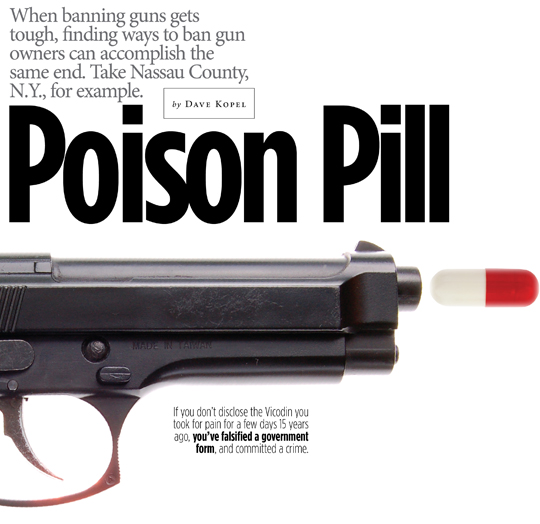
Pain Relievers It is difficult to conceive of anyone honestly answering “no” to narcotics use since, pharmacologically, “narcotics” include the Tylenol with Codeine you might take for a toothache, or the Vicodin you might have taken to control the post-operative pain of a minor surgery.
If you don’t disclose the Vicodin you took for a few days 15 years ago, you’ve falsified a government form and committed a crime. And soon enough, gun-licensing officials may have access to your prescription drug records.
Since June 2005, all New York pharm-acists have been required to electron-ically submit to the State Department of Health all the prescriptions written for drugs like these.
The Nassau County Police Depart-ment is already in routine contact with the State Office of Mental Hygiene regarding pistol license applications. We expect they will shortly be able to access the New York state drug database. They can then cross-reference it with the names of registered handgun owners to see who was prescribed medication in these categories. Anyone who has answered incorrectly would be open to prosecution for perjury.
Clearly there is no public safety need for the pistol licensing bureaucracy to demand information about a woman’s legal use of morphine when she was in a hospital 10 years ago recovering from childbirth. But if she fails to remember and to tell the police about it, then she puts her right to own a handgun at risk.
When you buy a gun in a store, you must fill out the federal Form 4473, which asks, “Are you an unlawful user of, or addicted to, marijuana or any depressant, stimulant, narcotic drug or any other controlled substance?” If the answer is “yes,” then of course you cannot buy the gun.
Notice that the federal inquiry is much narrower than the version now being used in New York. The federal form asks only about “unlawful” use or addiction.
We all know that strong pain relievers can create a feeling of pleasure, and that some people use the drugs illegally for that reason. But the NCPD is asking about legal use, not illegal use.
Pain relievers often carry warning labels, which tell patients not to drive or operate heavy machinery during use. Obviously, if you are feeling drowsy because you took some Tylenol, or just because you didn’t get enough sleep last night, you should not go hunting or go to the target range.
But when you buy a car, or heavy machinery, the government does not demand that you fill out a form detailing every instance of narcotic pain reliever use in your life. The general laws about reckless endangerment—including conduct involving the use of cars, heavy machines and firearms—already require that people who are impaired for any reason not use these powerful tools.
What about someone who uses painkillers, legally, on a daily basis? There are lots of such people. According to the Centers for Disease Control and Prevention (CDC), chronic pain is a leading cause of disability in this country. Many people require narcotic drugs on a daily basis—alone, or in combination with other medications. Do the gun control forces have a good argument that those people shouldn’t own guns?
Actually, the side effects of painkillers (drowsiness and mental pleasure) tend to disappear with continued use of the drug at the same dosage. That’s why illegal addicts (who are looking for mental pleasure, not for physical pain relief) take higher and higher doses.
Studies have found that the adverse effects of drowsiness or impaired cognitive ability are very temporary. According to a study of Finnish drivers, published in the German medical research journal Der Schmerz in August of this year, seven days after initiating opioid therapy, or after increasing the dose of opioid medication, “there was no general deterioration in patients’ driving ability.” Other medical experts have come to similar conclusions. (Rush University Medical Center, Nov. 25, 2007; “Opioids” entry in The Merck Manual—Home Edition.)
Anti-Depressants Another class of red-flag drugs on the NCPD list, anti-depressants, was found in a CDC study to be one of the most commonly prescribed types of drugs in the United States.
Although anti-depressants have very beneficial effects for the vast majority of patients, in 2007 the U.S. Food & Drug Administration (FDA) ordered warnings that advise doctors to closely monitor patients during the first two months of use. A 2005 University of Nebraska Medical Center survey found that only 7.5 percent of Nebraska doctors who prescribed anti-depressants saw their patients weekly during the first month of anti-depressant use. Hopefully, the new warning labels will lead to much more proactive monitoring by doctors.
Now suppose the police call up a doctor who has been successfully treating a 50-year-old woman for depression for the last 18 months. From a purely medical standpoint, the doctor would probably think, “I don’t think that there is any notable risk from her having a handgun.”
But if the doctor has a lawyer, the lawyer may advise, “You can’t guarantee that this woman—or, for that matter, a patient you treat for a broken leg—positively won’t do something wrong. And if you get 1,000 phone inquiries from the police about your patients over the course of your entire medical career, and just one of those patients does something wrong, you may get sued.”
Consequently, that doctor may be very reluctant to tell licensing authorities that the patient is no risk when it comes to firearm possession. One Nassau County gun owner we interviewed has lawfully used anti-depressant drugs for 10 years. When he went to renew his permit, he brought his handguns with him, because the NCPD requires that guns be “re-inspected.”
That gun owner told us that the police made it clear to him that they would confiscate his handguns on the spot unless his doctor told them that he posed no problem. (A written note from the doctor was not good enough for the police.) In this case, the doctor came through for the patient he had been helping for a decade, but not all doctors may be willing to be so forthright.
Tranquilizers The final class of red-flag drugs on the current list of potential disqualifiers is tranquilizers.
Major tranquilizers, such as Thorazine, are generally reserved for use in the treatment of psychosis—one of the most serious mental disorders. However, many Americans use minor tranquilizers as a calmative to relieve anxiety and to treat insomnia, among other conditions. For example, a person who is afraid of flying might be prescribed a small quantity to take when he or she has to fly for business. A doctor might prescribe some tranquil-izers for a busy young mother to take during periods of high stress—such as when her mother-in-law comes to stay for a week around Christmas. Or a man whose corporation is going through a difficult merger might be prescribed some pills to help him sleep better.
Again, there is no public safety interest in the government demanding that a person exercising his Second Amendment rights tell a bureaucrat about the time he took a tranquilizer two decades ago, when he had not yet overcome his fear of airplanes.
For less than 1 percent of tranquilizer patients, the tranquilizer has an opposite effect—causing talkativeness, excitement or anger.
So are we simply going to say that people who use minor tranquilizers at any time in their lives must now give up their constitutional rights?
The Slippery Slope The slippery slope is very steep, since many well-known drugs that are not intended to be psychoactive have mental side effects. Potential side effects of Lipitor—a cholesterol-lowering drug that accounted for a huge share of all U.S. prescriptions in 2007—include dizziness, emotional instability and lack of coordination.
Both Viagra and Cialis have vertigo and vision problems listed among their side effects. Of course, nobody who is feeling dizzy should go shooting, but does that mean that someone with a Cialis prescription should forfeit the right to defend his family against criminal attackers?
Prednisone is another drug not intended to change one’s mental functioning, but that can have mental side effects. It is used for a wide variety of conditions: arthritis, ulcerative colitis, asthma, allergic reactions and many more. Prednisone and related drugs are taken in high doses by more than 1 million Americans annually, and lesser doses by millions more. For many people, these drugs are often the best treatment for serious or life-threatening illness.
The Physician’s Desk Reference (PDR)—the standard manual that doctors use in prescribing medication—lists the potential side effects for Prednisone as dizziness, extreme changes in mood, changes in personality, weak muscles, vision problems, seizures, depression, loss of contact with reality, confusion and muscle twitching, among others.
When can we expect Prednisone to pop up on the red-flag list of firearm disqualifiers?
It is well accepted that high testosterone levels in men are associated with the potential for violence. Will it one day become a requirement to test all male handgun license applicants for testosterone levels, and then deny those who score in the top 10 percent?
As word gets out that in Long Island (and soon, perhaps, in other places) your confidential medical records will not be confidential if you choose to exercise your Second Amendment rights, it’s likely that fewer people will seek medical care and obtain the prescription drugs they need. The result could be a less healthy society.
“Cracking down” on law-abiding gun owners who lawfully use prescription drugs under a doctor’s guidance is just one more way in which excessive gun control harms public health.
The broader issue, of course, is not just prescription drugs. It is that someone who simply wants to exercise his or her constitutional right to possess a gun in his or her own home is being required to give up all medical confidentiality.
Under our legal system, the doctor-patient privilege is one of the very strongest zones of legal confidentiality. As gun control forces succeed with their invasion of this private zone, the follow-up invasion of other private zones will then become relatively easy. There are few legal protections for the privacy of employment records, and no legal protections for confidentiality about one’s past romances.
Will these be next?


 More Like This From Around The NRA